You’ve watered, you’ve fertilized, you’ve followed the plant tag to the letter. Yet, that one corner of your yard seems to fry everything you put in it, while another spot stays perpetually soggy and sad. It’s not you—it’s your garden’s hidden personality. Every yard is a patchwork of tiny, unique climates, called microclimates, where factors like sun, wind, and humidity create pockets that are significantly hotter, windier, or more humid than the general area. Understanding your garden microclimate for beginners isn’t about complex science; it’s about learning to see what’s already there. This guide gives you a simple, observational toolkit and a gentle routine to decode your yard’s challenging spots, turning your frustration into a strategic advantage for smarter, more resilient gardening.
A garden microclimate is simply a small area with its own unique climate, like a hot corner or a windy alley. To find yours, you’ll gather a few simple tools and follow a routine of observation to map out where it’s hot, windy, or humid. Think of it as getting to know your yard’s personality through a week of casual checks at different times of day. This practical map will then show you exactly where to place plants that will thrive, not just survive.
Your Microclimate Toolkit: What You Actually Need
Forget expensive gadgets. Assessing your garden microclimate is about sharpening your observational skills with a few simple, everyday items. This toolkit is about gathering clues, not lab data.

Photo by Kseniya Budko on Pexels
1. Your Eyes & A Notebook
This is your most important tool. A simple notebook or a notes app on your phone is where you’ll log patterns. The goal is to move from a vague feeling that “this spot is always windy” to a recorded observation like “west side path is consistently breezy after 2 PM.”
2. A Basic Thermometer (Helpful, Not Essential)
A simple digital thermometer can reveal surprising temperature differences. Place it in a suspected hot spot and a shady area at the same time. You might find a 10–15°F (5–8°C) difference, which is a huge deal for plant choices. If you don’t have one, your hand on different surfaces (soil, wall, patio) works too.
3. Your Sense of Touch
Your fingers are excellent moisture sensors. Poke the soil in different zones. Is it dry and dusty two inches down in a sunny bed but cool and damp under a tree? This direct feedback is key for understanding humid climate gardening basics in your own yard—humidity isn’t just air moisture, but soil moisture too.
4. A Simple Wind Indicator
Tie a brightly colored ribbon or piece of surveyor’s tape to a stake or fence post. Watch how it behaves in different areas. Does it flutter constantly in the alley between your house and shed? Does it hang limp in the corner by the fence? This visual makes invisible wind patterns obvious.
5. The Gift of Time
You can’t see everything in one snapshot. Plan to spend just a few minutes in your yard at different times over a week. This repeated looking is what turns random notes into a reliable map.
The Observation Routine: A Week in Your Yard
Now, use your toolkit in a gentle, low-pressure routine. Think of it as getting to know a new neighbor, not running a scientific experiment. Aim for observations over 3 to 7 days to catch patterns.
The Morning Check (8–10 AM)
Look for sun and shadow. Which areas are bathed in morning light, and which are still in deep shade? This is also when you might spot “frost pockets”—low-lying areas where cold air settles, often marked by lingering dew or frost when the rest of the lawn is clear.
The Midday Scan (12–2 PM)
This is peak heat time. Where is the sun most intense? Notice how shadows from trees, buildings, and fences create sharp lines of coolness. Feel different surfaces. A dark patio or south-facing wall will radiate significant heat, creating a “heat sink” effect.
The Evening Walk (5–7 PM)
Observe how the wind settles (or doesn’t). Your ribbon indicator will show if certain channels remain breezy as temperatures drop. This is also a good time to sense humidity. Does the air feel noticeably heavier in a sheltered, low corner? Do some soil areas still feel wet from the morning?
Jot down just a line or two for each check in your notebook. This routine is the core of how you identify yard microclimates without overwhelm.
Decoding What You Find: Hot, Windy, and Humid Zones
Your notes will start to tell a story. Here’s how to interpret common patterns and understand their causes.
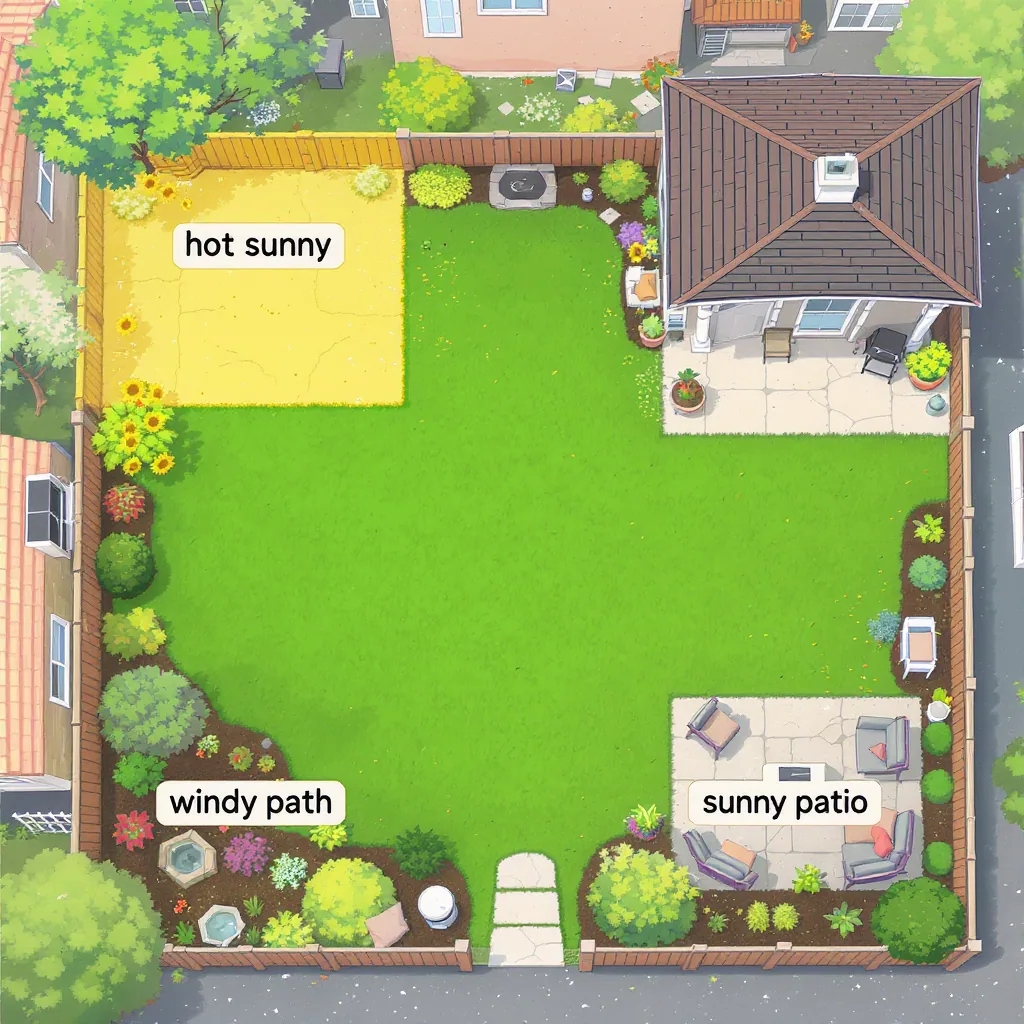
Hot & Dry Spots
These are typically sun-baked areas with reflective surfaces. A south or west-facing wall, a paved patio, or a gravel path absorbs heat all day and radiates it back, creating a mini-desert. Your thermometer will show higher readings here, and the soil will dry out fastest. These zones are perfect for drought-tolerant, sun-loving plants but a challenge for anything else.
Wind Tunnels & Breezy Corridors
Wind gets funneled and accelerated between structures. The gap between your house and garage, or a gate opening aligned with the prevailing wind, can create a persistent, drying gust. This is crucial for windy garden plant care; plants here lose moisture rapidly and may suffer physical damage. Your ribbon will dance constantly in these spots.
Humid & Damp Zones
These areas are often in deep, constant shade (like the north side of a house), have poor drainage, or are sheltered from breezes that would otherwise dry the air. Soil stays moist, air circulation is low, and mildew can be an issue. This is a classic scenario for applying humid climate gardening basics: improving airflow and choosing plants that tolerate “wet feet” and shade.
First Steps After Your Microclimate Map
With your personal microclimate map in hand, you can stop fighting your yard and start working with it. Here’s what to do (and not do) next.
Do: Use your map to make smarter plant choices. Place that sun-loving lavender in your identified hot spot, not in the shady damp zone. Put hardy, flexible shrubs where you noted wind tunnels to act as a living windbreak.
Do: Create simple interventions. A lattice panel or a row of tall grasses can disrupt a wind tunnel. Adding compost to a soggy area can improve drainage. A strategically placed bench or pot can provide afternoon shade to a scorching patio corner.
Do Not: Try to force a square peg into a round hole. Don’t repeatedly plant water-loving ferns in your hot, dry zone expecting different results. The goal is to match the plant to the place, not change the fundamental nature of the place through sheer willpower.
This shift in approach—from frustration to strategic placement—is the real power of understanding your garden’s unique personality.
Your Yard, Your Rules
What once felt like a problem—that scorching corner, that wind-whipped path, that perpetually damp patch—is now a defined feature of your garden’s landscape. Understanding these microclimates doesn’t limit your gardening; it liberates it. You’re no longer guessing why plants fail but confidently choosing where they will thrive.
This process of observation and adaptation is continuous and deeply rewarding. Each season, you’ll notice new subtleties. Embrace it. By working with the natural flows of sun, wind, and moisture in your space, you move from a gardener fighting against their yard to one collaborating with it, building a more resilient and beautiful garden in the process.